Friday, December 6, 2013

Nelson Mandela

There are rightly articles everywhere lionizing Nelson Mandela since his death yesterday. Others have said it much better, but his is a death that has hit me hard. The man was one of my heroes. He wasn't perfect by any means, but what he was able to achieve was absolutely monumental.
There are those who say he was a terrorist--interestingly those same people would probably in the next breath proclaim the rightness of resistance groups against the Nazis, even if said resistance groups targeted collaborators or were willing to risk citizen collateral damage. (Please note, I am not promoting violence, but South Africa was most definitely at war with its black citizens, and people do have a right to self-defense, and to resist against a tyrannical and oppressive regime.)
I've seen people complain that Mandela avoiding war/reprisals when he got out of prison was only doing the right thing and he shouldn't be lauded for that. Which ignores the situation: after 46 years of oppression, lack of the basic human rights, mass killings, mass torture, rape, kidnappings/disappearances caused by the police and government forces, those who resisted being imprisoned or having to flee into exile, and so on; it wasn't just doing the right thing to avoid violence. South Africa was absolutely on the brink of mass civil war. The right wing army was plotting to assassinate Mandela and re-institute apartheid. Black people were angry, wanting justice, wanting closure, wanting something for all those years of despair and heartache. And it is a testament not just to Mandela, but to all South Africans, that they managed to negotiate that transition peacefully. If it had been any other person other than Mandela leading, it is very very doubtful the outcome would have been so peaceful. Mandela came out of prison: renounced violence; instituted the truth and forgiveness trials (while still providing traditional prison terms to the worst of the lot); did as much as possible to heal the deep painful breaches between blacks and whites; and then stepped aside after his term was over, devoted his time to numerous charity causes and created a council of international elders to advise and work on issues like peace, climate change, poverty, and AIDS. And for all that, he absolutely is a hero, he absolutely does desire the praise and adulation.

Nelson Mandela's own words:
“where poverty exists, there is not true freedom. The world is hungry for action, not words. In this new century, millions of people in the world’s poorest countries—including South Africa—remain imprisoned, enslaved and in chains. They are trapped in the prison of poverty. It is time to set them free.”

"For to be free is not merely to cast off one’s chains, but to live in a way that respects and enhances the freedom of others."

"If you want to make peace with your enemy, you have to work with your enemy. Then he becomes your partner."
If you want to make peace with your enemy, you have to work with your enemy. Then he becomes your partner.
Read more at http://www.brainyquote.com/quotes/quotes/n/nelsonmand133378.html#Q32tWGauti3ekEUJ.99
If you want to make peace with your enemy, you have to work with your enemy. Then he becomes your partner.
Read more at http://www.brainyquote.com/quotes/quotes/n/nelsonmand133378.html#Q32tWGauti3ekEUJ.99

"I am not a saint, unless you think of a saint as a sinner who keeps trying."

"Social equality is the only basis of human happiness."

"Resentment is like drinking poison and then hoping it will kill your enemies."

"On my last day I want those who remain behind to say: 'The man who lies here has done his duty for his country and his people.'"

A list of articles to read on how the media tries to sanitize/downplay Mandela's radicalism, much as they have with Martin Luther King Jr:
http://www.clutchmagonline.com/2013/12/rip-nelson-mandela-5-must-read-pieces-south-african-leader-revolutionarys-passing/
Read/watch list on apartheid: http://colorlines.com/archives/2013/12/for_1990s_babies_start_here_to_get_to_know_mandela.html
A list of YA/children's books on South Africa: http://campbele.wordpress.com/2013/12/06/peace-reading/
tribute from Bishop Desmond Tutu http://www.washingtonpost.com/blogs/on-faith/wp/2013/12/05/the-moral-courage-of-nelson-mandela/

Wednesday, October 23, 2013

Spoken from the Heart and Speaking for Myself


Spoken from the Heart by Laura Bush is an weird autobiographical mix. The first half of the book, is all about Bush's childhood and early career as a schoolteacher and librarian. It goes into great detail about her life, personality, etc. The second part barely skims the surface of her later life, mostly just listing people and places, little insight into how she actually felt or handled being the First Lady. And certainly little insight into her husband's presidency, although of course she doesn't ever criticize any of his actions. The years in the governorship of Texas gets barely even a chapter.
And it's fine, it's readable, but not very memorable. Bush's pretty open about the car accident she was in near the end of high school; where she failed to stop at a stop sign (because teenage driver distracted by friends, because it was night and intersection not marked well) and t-boned another car, which killed the other driver. Who happened to be a friend from her high school. She is very open about how traumatic it was, and how much that event changed her. She talks about how she never went over to see the boy's parents, as she didn't think they'd want to see her, she left a few months later for college, etc. But that after having her kids, she realized that was incredibly wrong and she should have gone. Yet there's no explanation or reason given for why she didn't seek his parents out then. Was it that they both had passed on already? That she couldn't find out where they lived (which doesn't seem possible, surely once your husband is the president of the US, you could have tracked them down)? It never says why, just kind of leaves that hanging.
And there's a few places, during the presidency on her husband's policies (although she probably wisely mostly steers clear of wading into that mess), but also in her youth, of protesting too much. She declares that no girl at her high school ever drank. Even when she's talking about how the boys drank. And then at college, declares that not one of her friends from back home ever tried drugs at college. Which, I don't know, it could be true. But seems pretty unlikely.

And I have so many things to say on the whole topic of the role of the First Lady. It's the highest unpaid, unelected position in the US. The First Lady is expected to have her own "policies' and "agendas," a huge staff (Hillary Rodham* said she had 50 people in the First Lady's office, I don't think Bush ever says how many she had), do domestic and international public goodwill tours, serve as hostess to all these events, redecorate/repair the White House, and so on. But again, not paid, not elected. And if the woman takes on too much of an interest in politics, she's castigated and pilloried for it (Eleanor Roosevelt, Mary Todd Lincoln, Rosalynn Carter, Hillary Rodham). But if she doesn't seem to show enough interest, she's mocked and derided for being too domestic/stand-offish/shy/etc (Mamie Eisenhower, Bess Truman, Laura Bush, Nancy Reagan). It's completely bogus. Could you imagine the shock and outrage if a First Lady decided that she wouldn't do these things? Or worse, if she continued on her own career while her husband were president? A First Lady who declared she would keep working during her husband's presidency would probably completely scuttle her husband's career.

*Hillary kept her birth name and never actually took Clinton's last name. When Bill Clinton was governor, his staff took it upon themselves to start adding Clinton to the end of her name to her documents or event programs or whatever. She fought it for a while, but eventually gave up.


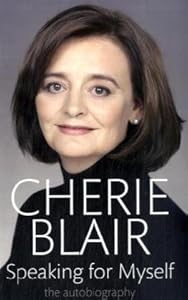
It's such a contrast to then read a book like Speaking for Myself by Cherie Blair. She was the first prime minister's wife to work while her spouse was in office, as a barrister who specializes in human rights law. The Blairs were also the family with the youngest children while in office. And the British press never really knew what to make of her; she got into a few controversies for some things she said, especially for being perceived as an anti-monarchist, and for once getting the paper in her bathrobe (which, was pretty naive, it was their first or second morning in the Prime Minister's house, and you don't realize that there are going to be reporters staked outside? When the British press are some of the most invasive and aggressive anywhere? Come on.). While I have no real appreciation for her husband, I did find her book quite interesting.
As I say, the role of prime minister's wife is very different. First, she doesn't have a "title" like First Lady. Second, she has a staff of about 4, to help her keep her schedule, answer mail, and whatever else. But that's it, she doesn't need to set an "agenda" because she isn't a politician, she doesn't need to help plan events and dinners, or re-decorate the house, you know why? Because they have people who are paid to do those things. Amazing.

So anyway:

Spoken from the Heart: 2 stars out of 5
Speaking for Myself: 3 stars out of 5

Thursday, September 26, 2013

It's a Music Video Kind of Day

Although I actually really loved Zeppelin, I'm not a huge fan of this particular song because it's so over-done. But Heart absolutely nails it. And you know they've nailed it when they get a standing ovation from Zeppelin plus tears from Page. That's how a homage is done.

So I hate Miley Cyrus' songs. And I've been avoiding her newest. But this country version is fantastic. And I'll pretend it's the only one out there.


I don't know what it is about Cher, but she's one of those people that gets carte blanche from me. She shows up in a waist-length newspaper shredded wig that looks like Mustafa's mane, and I say oh Cher, I didn't know that was something I needed in my life till now. Let me treasure you some more. (but, not as dirty as that sounds) Just like this video of her entrance on David Letterman where she descends on a swing while My Country 'Tis of Thee plays http://www.celebuzz.com/2013-09-25/cher-divad-lizzy-caplan-off-the-late-show-last-night/ (the second video in the article). Because somehow, that is perfect and everything I want about a Cher entrance.

A song that's apparently huge in The Netherlands right now. And I may have listened to this repeatedly since discovering it. 

Wednesday, September 18, 2013

Good news Wednesday

Because I think we can all use it right now. 

Maternal deaths in the Republic of Congo have dropped 50% over the last ten years: http://america.aljazeera.com/articles/2013/9/18/in-republic-of-congoarevolutioninmaternalhealth.html

Violent crime at a historic low: http://www.nationalmemo.com/u-s-crime-rate-stays-near-historic-lows/?utm_source=browser&utm_medium=browser

The Killers have a new song out:


Finally gaining some momentum lately in the move to get rid of the Washington football team's racist name: http://nativeappropriations.com/2013/09/canadian-itunes-app-store-censors-the-word-redskn.html

Awesome children's librarian reads to an alligator: http://www.slj.com/2013/09/public-libraries/queens-ny-librarian-reads-to-alligator-to-promote-summer-reading/#_

This is really good, you should watch it:

And finally, this is one of my favorite satire pieces on celebrities and charities. It makes me laugh every time I read it: http://the-toast.net/2013/09/03/the-celebrity-goes-to-africa/

Thursday, August 8, 2013

The Bletchley Circle

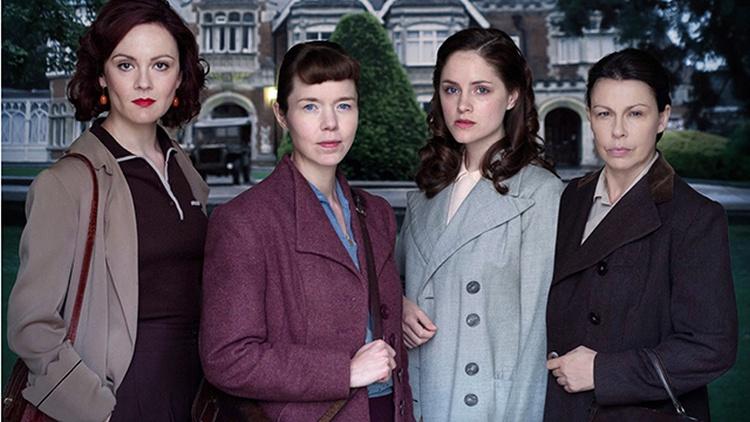
This British miniseries isn't perfect, is a little slow, but great acting and one of the most subtly feminist movies I've seen in a while makes it so much worth your while. The series follows four women who worked at Bletchley Park during World War II, which was the group, mostly women (80% of those who worked at Bletchley were women), who worked on cracking the German codes. After the war, the four women have mostly returned to their old jobs, or else gotten married and quit work all together. Due to the Official Secrets Act, the women (and men) were forbidden to divulge what they did during the war--certainly couldn't use it on resumes to find other work, weren't even supposed to tell your spouses, or have the opportunity of finding others who had done the same job and connecting that way. Seven years after the war, the main character, Susan, is now married with two children. She is trying to fit into the housewife life, but she is bored and stifled. When a serial killer starts targeting local women, she decides that with her experience, she can help track the killer through his patterns and stop him. Susan goes to some of the other women she worked with at Bletchley: Millie, Jean and Lucy, and the four team up to stop the killer.
It deals with the themes of women being forced out of jobs they loved or forced into domesticity; the patronization and dismissal of those in authority because they are women, or because they can't cite their credentials; and also the dismissal of their husbands, who don't want to hear about it, don't care what they did in the war, don't care about their wives' interests. Which isn't to say that the male characters are all horrible misogynists or anything, but they are definitely products of their time. Moreover, the series regularly smashes the Bechdel test, and follows not one but four women. When in 2012, only 27% of speaking roles in movies went to women; and when the number of women directors, producers and screenwriters is falling alarmingly, we need movies and series like this. That don't just have one token female character, but have several full-formed women; who aren't perfect, but are complex human beings just like their male counterpoints found just about everywhere onscreen. And the good news is that apparently there is going to be a second Bletchley series next year.


Further reading on the real Bletchley Park, which is pretty fascinating (unlike the movie Enigma...which was pretty boring):
https://en.wikipedia.org/wiki/Bletchley_Park
http://www.bletchleypark.org.uk/content/video-example.rhtm
http://www.telegraph.co.uk/culture/tvandradio/9520807/What-happened-to-the-women-of-Bletchley-Park.html

4 stars out of 5

Wednesday, August 7, 2013

Post-Apocalypse Beauty Pageant

In two post-apocalyptic series I've read, there was a kind of troubling way that beauty and disfigurement was dealt with. This isn't something solely confined to this genre, of course, but I felt like it was such a misstep and missed opportunity, especially because it's a main theme in these series, that I'll just focus on these two.
The first series is the Pure trilogy by Julianna Baggott. It takes place a decade or so after a series of bombs has gone off around the world(? maybe just U.S.). When the bombs exploded, people fused together with whatever they were holding or standing near. So the main character, who was 5 or 6 years old at the time, now has a doll's head for a hand. Her grandfather has a miniature fan lodged in his throat. The love interest has several live birds embedded in his back. Groups of people have fused into unrecognizable mass of arms/legs/heads. Those that fused with animals or the earth, have become mindless ravenous things that will kill and eat anything that crosses it. And so on. It's been about 15 years or so since the bombs, so the main character in the course of the series is now early 20s. There is a dome which was erected before the bombs went off, and the people in the domes are considered "pure," and weren't affected by the bombs, are considered superior; and the "pures" send out propaganda that one day, they will emerge and help fix everyone/everything. The main character has never seen any of these "pures," but is obsessed with getting her hand fixed and entering the dome. Despite every single person she knows being fused since the time she was around 5 years old, she constantly tries to hide her doll's head hand, and is horrified if anyone finds out what her fusion was. Despite her fusion being so incredibly minor, relatively speaking, as to be rather trivial compared to having living birds in your back, or having been fused onto a window pane or whatever other horrible hybrid and suffering constant pain because of it. Despite it being 15 years or so later, and having all that time to adjust.

The other series is the Birthmarked trilogy by Caragh O'Brien. This one has an environmental collapse with water/food/etc shortage, also with benevolent overlords who are perceived as superior in looks and intellect. The main character has a large birthmark (which is later revealed to actually be a burn) that covers much of one side of her face. She tries to arrange her hair to hide it, but it's still visible. She has incredibly low self-esteem, and is shocked, shocked I tell you, every single time it happens that someone doesn't run away screaming in horror. Despite the fact that no one has ever done so. Despite the fact that she has loving parents who tried to instill a sense of worth and self-esteem in her. Despite the fact that many of her immediate friends and neighbors accept her without a whole lot of comment. A few kids when she was younger teased or laughed at her, but otherwise, little to no bullying. No horror. No rejection. Additionally, almost every eligible man her age she runs across starts to fall in love with her. Seriously, over the course of just the first two books, she has three or four guys showing interest in her. And yet, she still obsesses almost on every page, about her scars, about her looks, about how horrible she must appear.

I realize that not everyone with obvious disability or disfigurement is going to accept that, and that my own issue is an invisible disability and so very different. And there are times with a disability that it ebbs and flows, sometimes you are dealing with it just fine, other times you're kicking against the pricks. But I think what bothers me about these series is that they could be about the main character coming to terms with what's happened to them. When there are so few obviously disfigured main characters, especially women, and especially that don't magically resolve itself within the course of the series; it could have been so different, and so much better. It could have been that the main character could have had a strong self-esteem in the first place. Or that the main character didn't have to obsess over beauty or her supposed lack thereof quite so much. Or even at all. Why does beauty have to be such a obsession at all, especially in a time and place when you're living with the effects of bomb radiation, little food/water/plants and every single other person you know is also disfigured; or when you're living in a land where the water and most plants have disappeared and even what little there is, is also in danger of disappearing? I don't know, it just seems like when you're in a constant struggle for survival, maybe there are other things worth obsessing over.  

Monday, June 10, 2013

Mirror Mirror (2012)


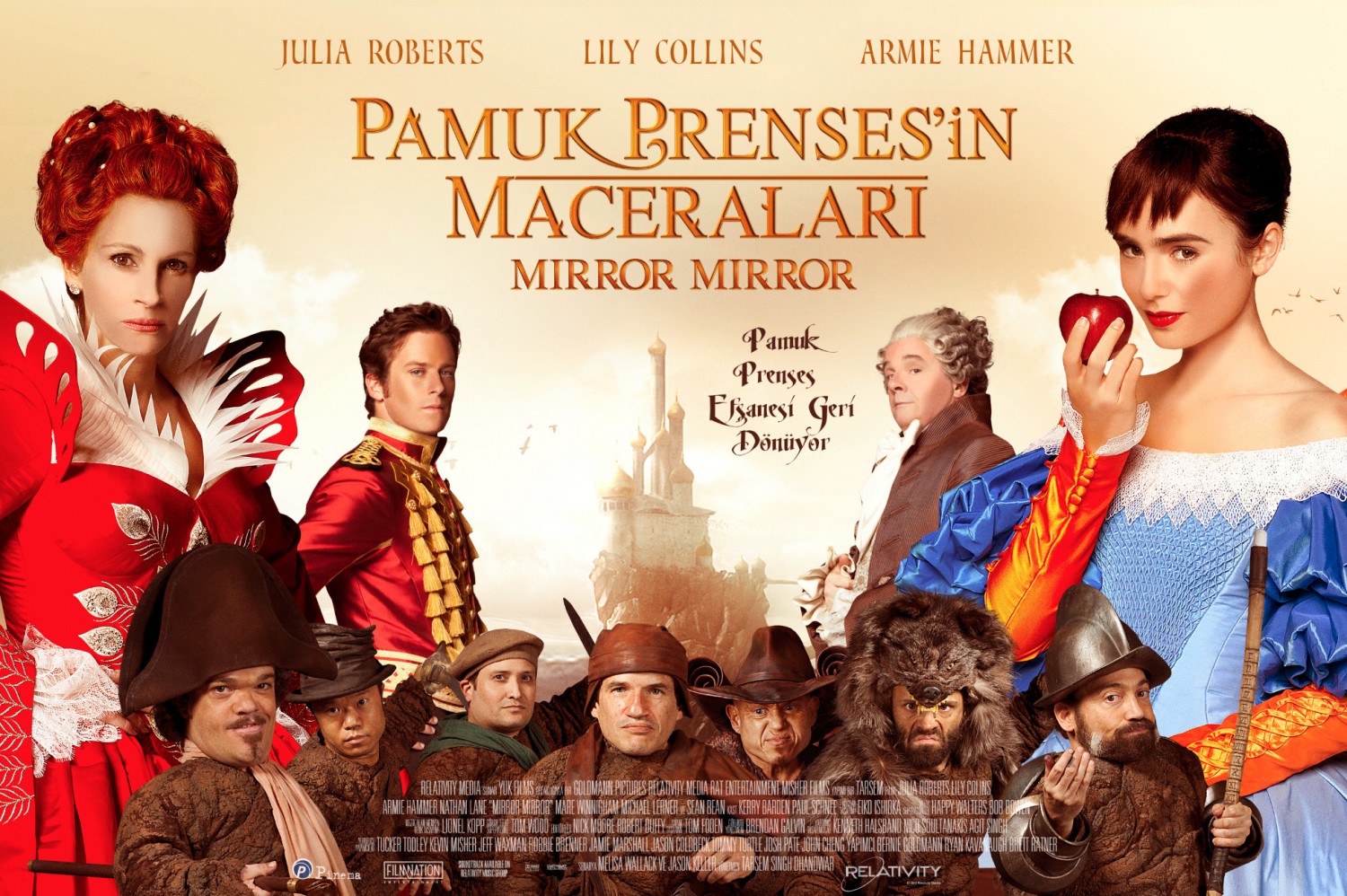
Not that I was expecting anything all that great from this movie, but such a massive massive fail.  Mostly in regards to the Prince, our supposed hero. So, the main story is the same, however, the dwarves that Snow White stays with are bandits rather than miners, and were forced out of their villages by the Queen's edicts. Snow White learns to fight from them. Which was really the only reason I watched it in the first place, looking for a Snow White who stood up for herself (well, that and it's about the only live actual version of Snow White that uses little people). I know that also happens in Snow White and the Huntsman, but the script and performances were all over the place in that one, and the dialogue often terrible, and so I didn't care for it.

When we first meet Prince Charming in Mirror Mirror, he gets attacked by bandits in the forest....those bandits turn out to be the dwarves, wearing stilts. The Prince repeatedly mocks the dwarves even after he's defeated: referring to them as children, as harmless, uses ableist slurs, how embarrassing/humiliating/wrong this was to get beaten by them. And then when he eventually gets free and reaches the Queen's castle, he lies (several times) about who attacked him, and builds his attackers up to enormous size and strength, because he can't have people knowing the truth.
The Prince once he's at the court, falls in with the Queen's party line, having absolutely no qualms about how opulent and frivolous her court is, despite seeing how how starved and mistreated her people are, and the severe punishments inflicted on them by her guards. He is so taken in, that he goes back out with her guards to attack the bandits; and that's where he fights with Snow White. And during the course of their fight, he spanks her repeatedly with his sword. Hilarious. Just hilarious. And tells her that girls can't fight, she should go back to her rightful place (doing girly things), etc.

And then there's the Queen. Of course she retains her jealous obsessive nature. No attempted motive for why she does what she does (unlike Snow White and the Huntsman, which however badly and problematically done, tries to give the Queen a back story of being abused and hurt by the men in her life, so she decides to exact revenge on other men). There's this weird awful scene of the Queen getting ready for the ball; and she undergoes a beauty treatment, where birds literally poop right on her face, she gets stung in the lips by numerous bees, maggots/worms eating her dead skin to exfoliate, and other gross things. I have no idea what the scene is supposed to be; if it's a commentary on the horrible things in beauty products, it fails. If it's supposed to be a commentary on a vanity obsessed culture where people will undergo gross and dangerous procedures to look beautiful, it fails. It's just gross, no exploration or commentary here.
And as obnoxious as Julia Roberts looked in the trailer, bless her for trying. It's like she realized how terrible the film was, and decided to chew the scenery for all she was worth to try and entertain herself. And she manages to be about the only bright spot in a bevy of bad performances. Even Nathan Lane just gave up and played dead....when another actor manages to out-ham Lane, you know something is wrong.
Finally, the ending. We've got our horrible Prince marrying Snow White (despite him finally coming over to the people's side with Snow White, there's never any really change or growth in his character--he certainly never really apologizes to all and sundry for being such a jerk). Snow White actually has been slightly sympathetic to this point--although she does know how brutal the Queen is to her people, and does nothing about it for years. Even once she escapes and lives in the forest, she still really doesn't do anything to help her own people for quite a while. At least in the other Snow White film, Snow White has been locked up in a tower for years and so has no idea what is going on outside and what her people are going through. And then when she does escape, becomes the figurehead of a rebellion against the Queen. So anyway, back to Mirror Mirror, it's their wedding, and Snow White's father has come back (instead of dying he had been turned to a beast by the Queen); and the Queen shows up in disguise. With a poisoned apple. And our supposed heroine smilingly forces the Queen to eat the poisoned apple herself to commit suicide. At which point a joyful Bollywood song begins playing and everyone dances on the Queen's figurative grave and the end. (Don't ask me about the song, for some reason Disney loves to end with a song that is jarringly out of step with the rest of the movie.)

1 star out of 5